How to Solve a Rubik's Cube (for Solve The Cube)
Last updated:
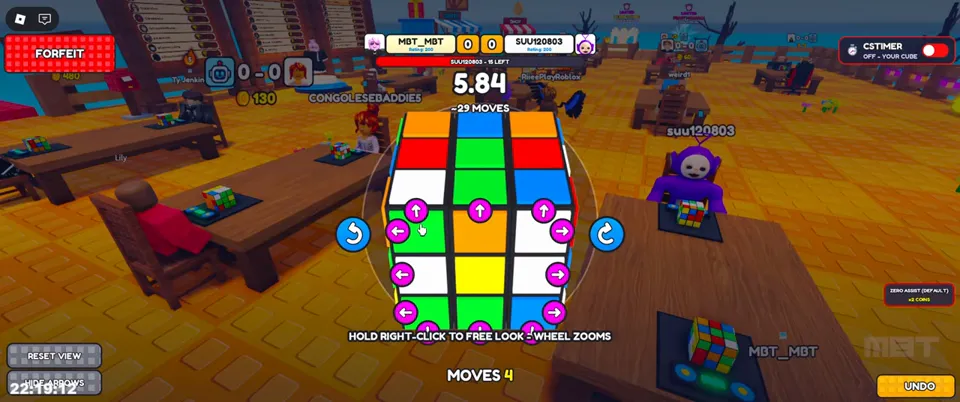
Solve The Cube uses "different cube types, same real algorithms", so learning a real Rubik's Cube method makes you better in the game. In ZERO ASSIST mode the game gives you a scrambled cube and no key sequence, so you have to solve it yourself. This page teaches the standard beginner (layer-by-layer) method in seven steps.
Why learn a real method?
In the default modes, Solve The Cube shows a key bar and you type the sequence from memory. In ZERO ASSIST there is no sequence: the official description says you "solve a real scrambled cube yourself". Every face turn still uses the game's keys (see controls), so you need two skills: knowing which moves to make, and knowing which keys make them. This page covers the first. The notation page connects moves to letters.
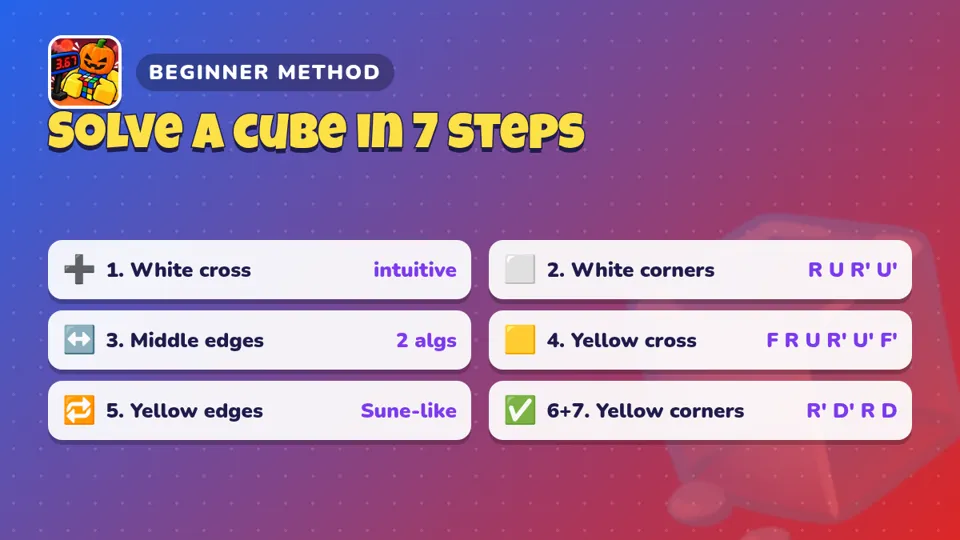
The 7 steps of the beginner method
- White cross. Put the four white edge pieces around the white centre so their side colours also match the side centres. Do this intuitively; there is no algorithm to memorise.
- White corners. Hold the white face down. Find a white corner in the top layer, put it above where it belongs and repeat
R U R' U'until it drops in correctly. - Middle layer edges. Turn the cube so white is on the bottom. Find a top-layer edge with no yellow, line it up with its centre, then insert it to the right with
U R U' R' U' F' U For to the left with the mirrorU' L' U L U F U' F'. - Yellow cross. With yellow on top, repeat
F R U R' U' F'until you have a yellow cross (dot → L-shape → line → cross). - Match the yellow edges. Use
R U R' U R U2 R' Uto swap edges until each yellow edge matches its side centre. - Place the yellow corners. Use
U R U' L' U R' U' Luntil every corner is in the right spot, even if it is twisted. - Twist the yellow corners. Hold the cube still, and repeat
R' D' R Don each unsolved corner in the front-right-top spot, turning only the top layer between corners. The cube will look broken halfway through. Keep going.
How this maps to the game's methods
The in-game methods are named after real solving systems: Beginner (layer by layer, like this page), Corners First (4,000 Coins), CFOP, ZZ and Petrus (20,000 Coins each). Better methods cut the number of moves, which in the assisted modes means fewer keys to type. The beginner method usually takes around 100 moves. CFOP solvers average about 55–60.
Practice plan
- Day 1: learn steps 1–3 on a real cube or an online simulator.
- Day 2: learn steps 4–7 and do five full solves.
- Day 3: try ZERO ASSIST 2x2 first (fewer pieces), then 3x3. See the 2x2 guide.
- After that: work on finger tricks and fewer pauses, then think about CFOP.
Tips for ZERO ASSIST rounds
- Use free look (hold right-click) to inspect the back faces before you start.
- Speed comes from not stopping, not from turning fast. Smooth, steady turns beat bursts.
- The "Sub 5" badge (solving in under 5 seconds) had been earned by only about 3,250 players by October 26, 2026, so don't expect it early.
Sources: Rubik's Cube notation and solving steps are standard speedcubing knowledge (World Cube Association notation). Game details come from the official Roblox game page, the public Roblox APIs (checked October 26, 2026, ~4:15 PM PKT) and the gameplay video "Solve The Cube By Guess the Studios! Basic Overview" by MBT (Oct 24, 2026). Anything we could not confirm in-game is labelled to be verified.
Video guide
Frequently asked questions
Can you really solve the cube yourself in Solve The Cube?
Yes. ZERO ASSIST mode gives you a real scrambled cube with no key sequence, so you solve it with your own method.
What is the easiest way to solve a Rubik's Cube?
The beginner layer-by-layer method: white cross, white corners, middle edges, yellow cross, yellow edges, yellow corner positions, then yellow corner twists.
Which method is fastest in Solve The Cube?
Methods with fewer moves, such as CFOP, ZZ and Petrus, mean fewer keys per solve. Petrus and ZZ cost 20,000 Coins each.